Why Tobago Autonomy
It’s critical that Tobago plays a meaningful role in the fulfillment of the national Sustainable Development Goals as well as in the advancement and alignment of Tobago’s development towards the attainment of Vision 2030 of Trinidad and Tobago.
The History of the Fight for Tobago Autonomy
1763: Tobago becomes a British possession, administered under a British colonial constitution by the Government of Grenada.
1803: Tobago remains a British possession after frequent changes of hands between the British and French.
1874: Tobago’s bicameral system is abolished and replaced by a single chamber legislature with 14 members (6 nominated and 8 elected).
1876: Tobago becomes a Crown Colony with a solely nominated Legislative Council.
1889: Tobago is united with Trinidad, forming the joint colony of Trinidad and Tobago with one Governor, judiciary, and code of laws. Tobago retains its own financial board and separate Treasury.
1925-1932: James Biggart, Tobago’s first elected member in the Trinidad and Tobago Legislative Council, and subsequently A.P.T. James (1946-1961), advocate for Tobago’s development amidst neglect.
1977: Arthur Napoleon Raymond Robinson (Democratic Action Congress) presents a motion in Parliament calling for internal self-government for Tobago, endorsed by Winston Murray.
1979: Lionel Seemungal drafts a Bill proposing the establishment of a Tobago Island Council with legislative and executive powers, but it is rejected by the Cabinet.
1980: The Tobago House of Assembly Act is passed, establishing the Tobago House of Assembly (THA) with limited powers.
1996: The THA and the Tobago House of Assembly Fund are enshrined in the Constitution (Chapter 11A). The Tobago House of Assembly Act, 1996 replaces the 1980 Act.
2005: The THA adopts a resolution calling for legislative and constitutional reform to accord democratic internal self-government to Tobago.
2006: A draft new Constitution for Trinidad and Tobago by Sir Ellis Clarke fails to address the constitutional relationship between the two islands and internal self-government for Tobago.
2010: The Tobago Forum group presents proposals for constitutional reform from a Tobago perspective, with 75% of respondents preferring a federal system/internal self-government/equality of status.
2012: The Government publishes a Green Paper for public consultation on internal self-government for Tobago, proposing a Constitution (Amendment) Bill, 2011.
2013: The Constitution (Amendment) Bill, 2013, aiming to enhance the legislative and executive powers of the THA, is laid in the House of Representatives but abandoned.
2014-2016: The Forum of Political Leaders conducts extensive consultations and drafts the Constitutional (Amendment) Tobago Self-Government Bill, 2016.
2017: The Tobago House of Assembly unanimously passes the Constitutional (Amendment) Tobago Self-Government Bill, 2016, forwarded to the Cabinet.
2018: The Constitution (Amendment) (Tobago Self-Government) Bill, 2018, developed after a long process, is submitted to the Parliament of Trinidad and Tobago for consideration.
March 2018: The Bill was sent to a Joint Select Committee
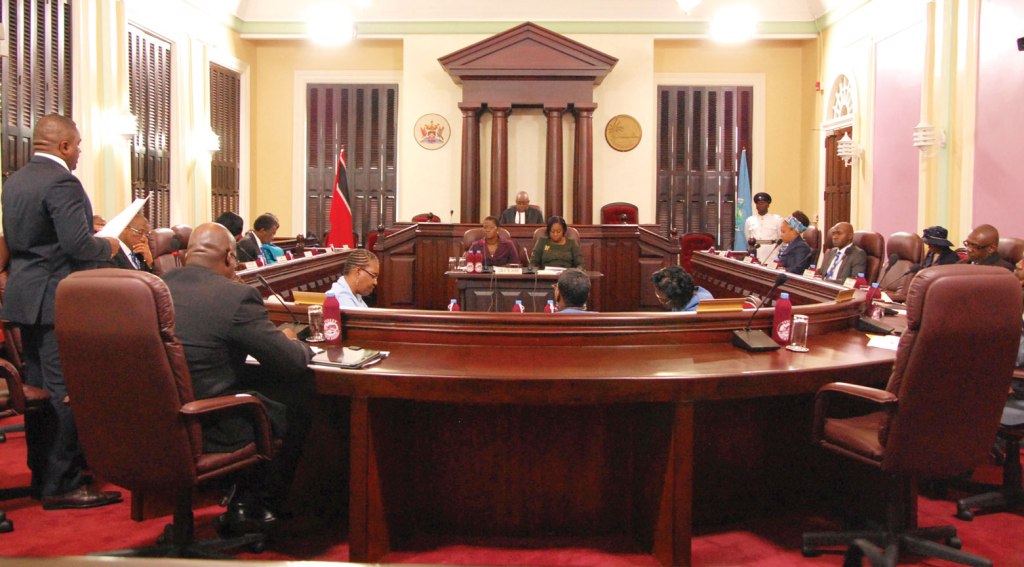
2018-2019: The Committee solicited comments and submissions and held public hearings with stakeholders from Tobago and Trinidad, as well as legal and other experts
2020: The life of the Committee ended, and upon the resumption of the new Parliament, the Bill was referred to a new committee.
2020: The Constitution (Amendment) (Tobago Self-Government) Bill, 2020, was introduced by Dr. Keith Rowley, Prime Minister, to amend the Constitution, to confer self-government on Tobago, and to provide for the creation of a Tobago Island Government.
2021: A Joint Select Committee proposes revising and dividing the 2018 bill into:
- The Constitution Amendment (Tobago Self-Government) Bill, 2021 to amend the Constitution and grant internal self-government to Tobago.
- The Tobago Island Government Bill, 2021 as a companion bill for administrative and procedural matters.
2021: Public consultation held at the Victor E. Bruce Financial Complex in Scarborough, Tobago, where stakeholders and committee members discussed the draft proposals for the Bill.
June 2021: The report of the Joint Select Committee on the proposed bills is laid in Parliament and debated, but the debate ends prematurely due to a walkout by the opposition.
January 2024: Prime Minister Dr Keith Rowley promised to bring two Tobago self-governance bills back to the Parliament to be voted on in 2024. This promise was made at the Funeral of Hochoy Charles, the first Chief Secretary of the Tobago House of Assembly
December 2024: The Tobago Island Government Bill 2021 is passed in the House of Representatives while the Constitution (Amendment) (Tobago Self-Government) Bill 2020 fails to get the 75% majority needed. See HERE.
See More
2018 – Statement by the Prime Minister on Tobago’s Autonomy
Tobago CivilNET has surveyed the Tobago public about its attitudes towards Tobago Autonomy. Click HERE to see our surveys page for more information.
 Tobago CivilNET